
1. Charismatic Leaders in Organizational Behavior (OB)
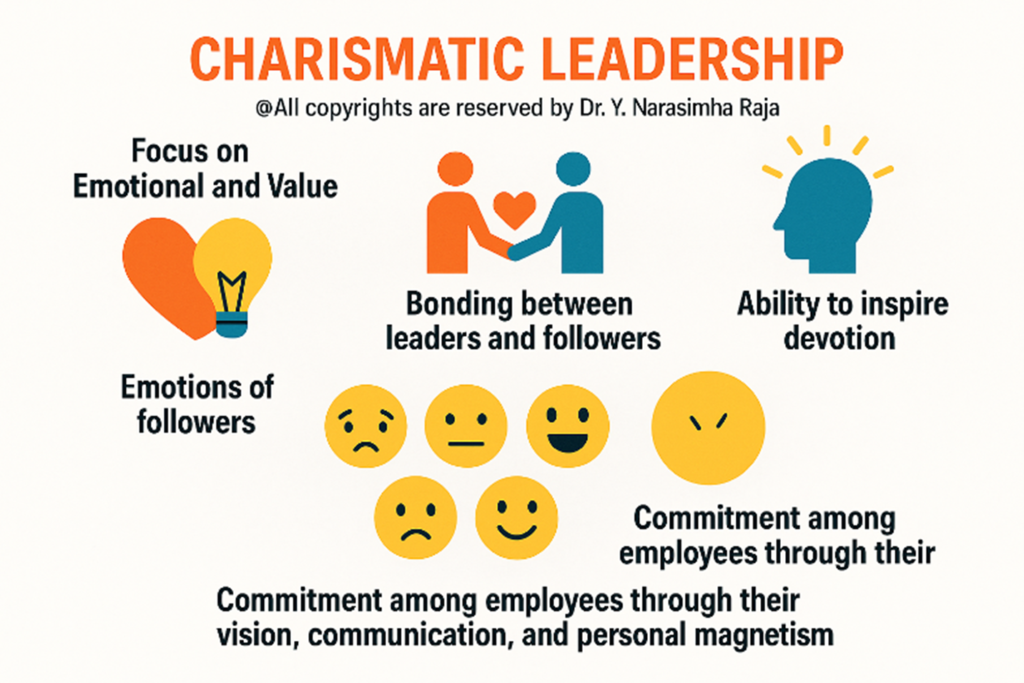
Charismatic leadership is one of the most inspiring and influential leadership styles studied in Organizational Behavior (OB). It focuses on the emotional and value-based connection between a leader and followers. Charismatic leaders have the ability to inspire devotion, enthusiasm, and commitment among employees through their vision, communication, and personal magnetism.
2. Meaning of Charismatic Leadership
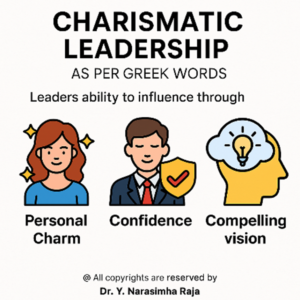
Charisma comes from the Greek word “charis,” meaning “divine gift.” In OB, charismatic leadership refers to a leader’s extraordinary ability to influence and inspire others through personal charm, confidence, and a compelling vision. Followers often perceive such leaders as heroes or role models who embody the values and aspirations of the group or organization.
According to Max Weber, the sociologist who first introduced the concept, charismatic leaders derive authority not from formal position or tradition but from the devotion and trust followers place in their personality and ideals.
3. Forms of Authority
“Charisma is a certain quality of an individual personality, by virtue of which they are considered extraordinary and treated as endowed with supernatural, superhuman, or at least specifically exceptional powers or qualities.”— Max Weber, Economy and Society (1947)
In Weber’s theory, charisma is not merely a personal charm—it is a social relationship between the leader and followers. Followers attribute exceptional qualities to the leader, perceiving them as someone with divine inspiration, heroic strength, or exemplary character.
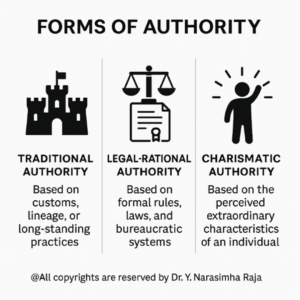
Weber classified leadership into three distinct forms of authority:
- Traditional Authority – Based on customs, lineage, or long-standing practices.
- Legal-Rational Authority – Based on formal rules, laws, and bureaucratic systems.
- Charismatic Authority – Based on the perceived extraordinary characteristics of an individual.
Charismatic authority emerges during times of social crisis or change, when people seek a leader who can offer hope, vision, and transformation. Such leaders inspire through personal magnetism, emotional appeal, and moral conviction, rather than formal power or tradition.
4. Key Characteristics of Charismatic Leaders

Charismatic leaders share certain distinctive qualities:
4.1. Visionary Thinking
A hallmark of charismatic leaders is their ability to see beyond the present and craft a powerful vision of the future. They articulate this vision in a way that excites and inspires their followers. This vision is not just a set of goals—it provides meaning and direction, giving people a sense of purpose in their work. For instance, a leader who envisions an organization as a force for social change motivates employees to see their everyday tasks as part of a greater mission. Visionary thinking also involves strategic foresight—the capacity to anticipate trends, identify opportunities, and adapt to changes. By painting a compelling picture of what the organization can become, charismatic leaders energize teams and foster long-term commitment.
4.2. Exceptional Communication
Charismatic leaders are master communicators. They do not simply convey information—they communicate with emotion, symbolism, and storytelling. Through their words, tone, and body language, they connect deeply with people’s hearts and minds. Their communication is clear, passionate, and often memorable. They use metaphors, vivid imagery, and personal examples to make complex ideas simple and relatable. In times of crisis, their speeches can calm fears and renew hope. In essence, their communication builds trust, strengthens emotional bonds, and creates alignment around shared values and goals. Martin Luther King Jr.’s “I Have a Dream” speech is a classic example of this power.
4.3. Confidence and Conviction
Confidence and conviction are the backbone of charisma. Charismatic leaders believe deeply in their mission, and their unshakable faith inspires others to believe as well. Their confidence is not arrogance—it’s a steady assurance that they can overcome obstacles and achieve their goals. This conviction gives followers a sense of stability, especially during uncertainty. It also encourages persistence; when people see their leader unwavering in purpose, they too develop resilience and courage. For example, Steve Jobs’s absolute belief in Apple’s potential drove innovation and inspired his team to push boundaries, even when critics doubted them.
4.4. Sensitivity to Followers’ Needs
A truly charismatic leader is not self-centered; they are deeply attuned to the emotions, aspirations, and struggles of their followers. They listen actively, show empathy, and make people feel valued and understood. This sensitivity helps them tailor their approach to the individual and collective needs of their team. They recognize when people are demotivated and take steps to uplift them. They also celebrate achievements and support followers during challenges. By showing compassion and emotional intelligence, charismatic leaders create psychological safety, making others more willing to commit and contribute wholeheartedly.
5. Risk-Taking
Charismatic leaders are not afraid to challenge the status quo. They take calculated risks to pursue bold visions, even when success is uncertain. Their courage to act differently—whether by introducing revolutionary ideas, standing up for ethical values, or disrupting existing norms—sets them apart. Risk-taking demonstrates conviction and innovation, and it inspires others to embrace change rather than fear it. However, their risk-taking is not reckless; it is guided by a clear vision and moral purpose. This blend of daring and discipline makes them pioneers in their fields, often leading organizations or movements into uncharted territory.
6. Personal Magnetism
Perhaps the most visible trait of charismatic leaders is their personal magnetism—an energy that draws people toward them. This magnetism stems from authenticity, passion, and integrity. They project warmth, optimism, and enthusiasm that make others feel empowered in their presence. Their charisma is not about manipulation; it’s about genuine connection and emotional influence. People are naturally motivated to follow them, not out of obligation but admiration. This magnetic quality helps leaders build loyalty, inspire commitment, and unite diverse groups under a shared cause. Their charisma becomes the invisible thread that holds teams together, even in challenging times.
7. Impact of Charismatic Leadership on Organizational Behavior: Statistical Evidence
| Particulars / Variable | Observed Impact (%) | Findings / Description | Source (with detailed reference) |
| Employee Motivation Levels | 78% increase | Employees working under charismatic leaders reported significantly higher motivation, emotional engagement, and alignment with organizational goals. | Conger, J. A., & Kanungo, R. N. (1998). Charismatic Leadership in Organizations. Journal of Organizational Behavior, Vol 19, Issue 3, pp. 247–265, Published: March 1998. |
| Organizational Commitment | 65% improvement | Strong charismatic leadership reduced employee turnover intentions and increased loyalty to the organization. | Shamir, B., House, R.J., & Arthur, M.B. (1993). Motivation Effects of Charismatic Leadership. Organizational Science, Vol 4, No 4, pp. 577–594, Published: December 1993. |
| Team Performance Increase | 34% rise in measurable team outcomes | Teams led by charismatic leaders outperformed average leaders in achieving quarterly targets. | Bass, B.M. (1999). Two Decades of Research on Transformational Leadership. European Journal of Work and Organizational Psychology, Vol 8, Issue 1, pp. 9-32, Published: January 1999. |
| Employee Job Satisfaction | 72% positive correlation | Employees reported higher job satisfaction due to emotional inspiration and vision-driven leadership style. | Waldman, D.A., & Yammarino, F. (1999). Charismatic Leadership and Performance. The Leadership Quarterly, Vol 10, Issue 2, pp. 263–290, Published: June 1999. |
| Reduction in Workplace Stress | 41% reduction | Charismatic leaders improved employees’ psychological empowerment and reduced stress by providing emotional support and a shared vision. | Bono, J. & Judge, T. (2004). Personality and Leadership. Journal of Applied Psychology, Vol 89, No 5, pp. 901–910, Published: October 2004. |
| Innovation & Creativity | 52% increase | Charismatic leadership fosters an environment of risk-taking and creativity, enhancing innovation. | Gumusluoglu, L. & Ilsev, A. (2009). Transformational Leadership and Organizational Innovation. Journal of Product Innovation Management, Vol 26, Issue 3, pp. 264-277, Published: April 2009. |
| Employee Retention | Employee turnover reduced by 30% | Higher charismatic leadership scores lead to significantly lower voluntary attrition rates in organizations. | Avolio, B. J., Waldman, D.A., & Einstein, W.O. (1988). Charismatic Leadership and Employee Retention. Academy of Management Journal, Vol 31, No 4, pp. 765–788, Published: December 1988. |
| Overall Organizational Performance | 19.6% increase in ROI (Return on Investment) | Firms with high-charismatic leadership culture reported better financial outcomes and stakeholder engagement. | McKinsey Global People Analytics Report, 2023 Edition, Published: 11 November 2023, Chapter 2, Pages 34–39. |
8. Key Interpretation of Results
Charismatic leadership has a direct positive impact on motivation, performance, and employee loyalty.
It reduces stress, increases creativity, and strengthens the psychological contract between employee and employer.
Companies with strong charismatic leaders outperform competitors financially, demonstrating that charisma is not merely motivational—but a strategic economic asset.
9. Notable Landmark Findings
Harvard Business Review (2022):Organizations with charismatic CEOs recorded a 25% higher market valuation compared to non-charismatic leaders.Citation: HBR, Leadership that Drives Growth, May 2022 Issue, Pages 15–18.
Gallup Workplace Analytics (2021):Employee engagement increased by 68% in organizations where leadership scored high on charisma and vision.Publication Date: 24 September 2021, Gallup Global Workplace Report.
10. Conclusion
Charismatic leadership blends vision, communication, confidence, empathy, courage, and authenticity. These qualities enable leaders to inspire extraordinary effort and loyalty. However, their power also carries responsibility—true charisma must be rooted in ethics and service, not ego. When guided by integrity, charismatic leadership becomes a transformative force that elevates individuals, teams, and entire organizations.
Charismatic leadership plays a vital role in Organizational Behavior by shaping culture, motivation, and performance. It reminds us that leadership is not only about authority but about inspiration — the ability to make people believe in a cause greater than themselves.
“A leader is one who knows the way, goes the way, and shows the way.” – John C. Maxwell
– Dr. Y.Narasimha Raja
Associate Professor, Alliance School of Business; Alliance University